ESG Due Diligence in Private Equity Acquisitions: what to assess before investing
What ESG due diligence is in an acquisition, what the assessment criteria are and how this process helps protect the investor and support disclosure obligations.
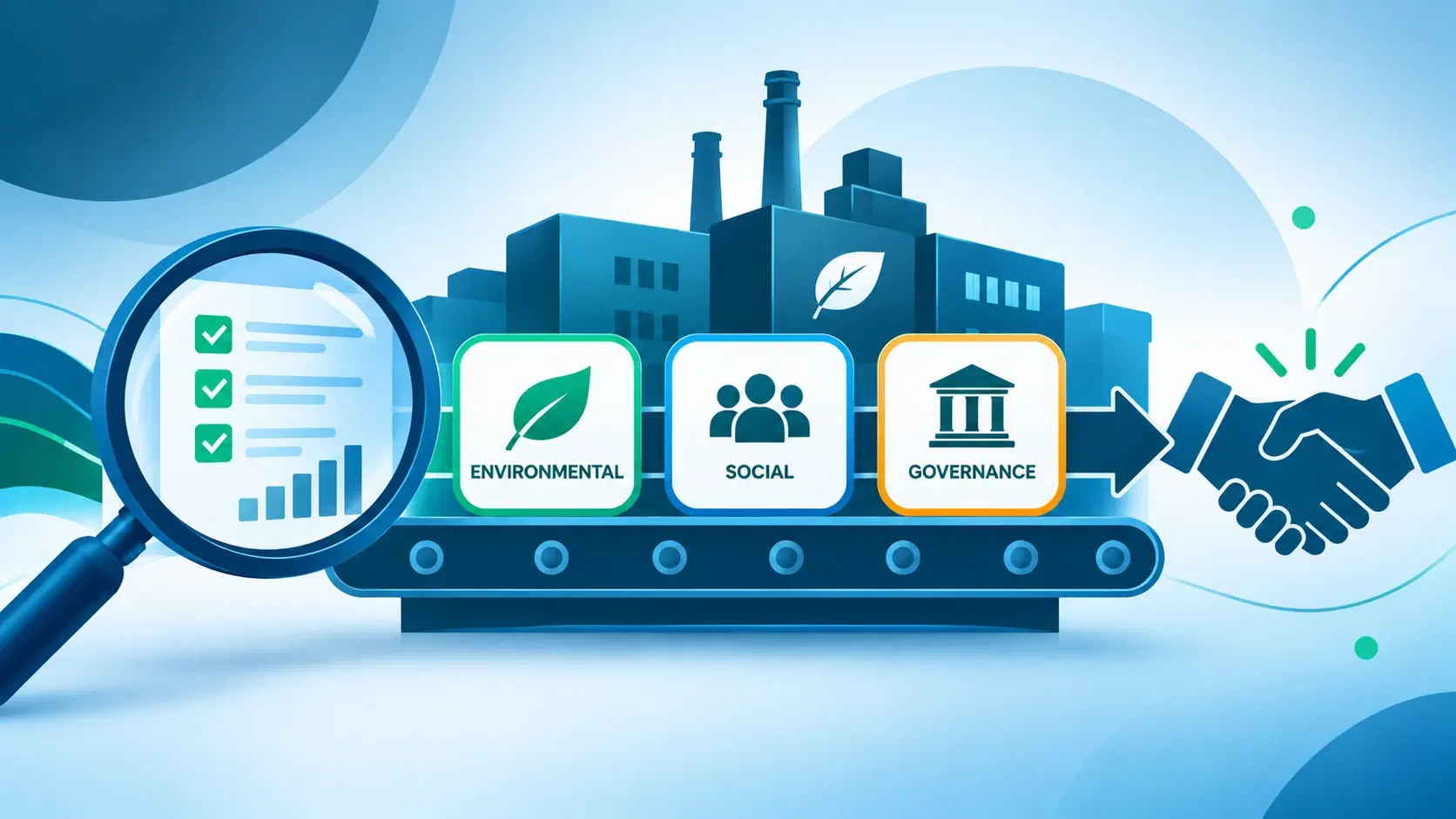
In brief
- •What it is: the analysis of a target’s ESG risks and opportunities before the investment, linked to the price, the deal terms and the value creation plan.
- •What it covers: environment, social and governance, both the risks for the fund and the target’s impacts on people and the environment, and the data required by the fund and its LPs.
- •What it produces: a basis for deciding, for example to proceed, renegotiate, require a remediation measure, request more information or walk away.
- •For SFDR funds: it supports the fund’s reporting, without replacing the legal analysis.
Why ESG due diligence has gained weight in acquisitions
An unidentified environmental liability, a high accident rate or a corruption case in a supplier’s history can reduce the value of a portfolio company long after the acquisition has closed. When the LP asks how the fund assesses these risks, the answer lies in the due diligence process, which is why it should be structured, repeatable and documented.
ESG due diligence also meets a need for data. In a fund that promotes environmental or social characteristics, or that commits to PAI and Taxonomy alignment, the target is the first source of information, and each SFDR disclosure category implies different data requirements. Data collection supports the fund’s reporting, but it does not replace the legal analysis nor, on its own, determine the fund’s SFDR category.
From our experience, many smaller targets already apply good practices, such as energy audits or safety systems, but without organised information, which makes the process slow both in discovery and in assessment.
Two questions ESG due diligence must answer
What can destroy value?
Environmental liabilities, non-compliance and unmanaged regulatory risks, labour disputes, dependence on assets exposed to climate.
What can create value?
Energy savings, access to green financing, a better position with large customers and a solid ESG exit narrative.
What it is and what it should include
ESG due diligence complements the financial, legal and commercial analysis, and can take place at three levels of depth, depending on the stage of the process.
Initial screening
Checking the target against the fund’s exclusion list and identifying warning signs, before spending more resources.
Confirmatory due diligence
Analysis of documents, interviews with management and, where justified, site visits. For industrial targets, a site visit is particularly relevant to assess the risk of soil and groundwater contamination, which in some cases can be a deal breaker. Identification of CAPEX and OPEX and recommendations.
Baseline
A set of metrics that feeds the first 100 days plan and reporting to the fund.
Two directions of analysis
A comprehensive ESG due diligence looks at the risks that ESG issues pose to the fund and the target, and also at the adverse impacts the company may cause to workers, communities, human rights and the environment, including in the value chain. The OECD guidelines for responsible business conduct treat this second analysis as a central part of due diligence for companies and investors.
The depth should follow the materiality of the sector. In an industrial target, emissions, safety and waste often weigh more, while for a healthcare provider data protection and working conditions gain weight. The SASB standards, now integrated into the ISSB, identify the material ESG topics by sector and are a good source to consult when defining the scope of the analysis. The following table includes examples of an assessment baseline, to be adapted to each target.
| Dimension | What to assess | Warning signs | Evidence to request |
|---|---|---|---|
| Environmental | Energy and emissions in Scopes 1, 2 and 3, permits, waste, water, exposure to physical and transition climate risks | Liabilities or contamination, missing permits, heavy dependence on fossil fuels | Energy bills, permits, environmental reports, certifications (e.g. ISO 14001) |
| Social | Health and safety, working conditions, child and forced labour, discrimination, trade union rights, supply chain, gender pay gap, data protection, cybersecurity | Serious accidents, labour disputes, signs of child or forced labour, discrimination, restrictions on trade union rights, high-risk suppliers without controls, GDPR non-compliance or data incidents | Accident rate, certifications (ISO 45001), HR and human rights policies, whistleblowing and remedy mechanisms, supplier audits, consultation with workers or communities where the risk justifies it |
| Governance | Board, anti-corruption, whistleblowing channel, risk management and capacity to innovate | Concentration of power, absence of policies, conduct incidents | Policies, minutes, incident log, description of the risk management system. Innovation management systems |
| Data and maturity | Who collects, validates and reports ESG data and how often | Scattered data, with no owner or history | Spreadsheets, systems, appointment of an owner |
| Fund requirements | Compatibility with the exclusion list, PAI, Taxonomy and, where applicable, DNSH | Difficulty answering on excluded activities, impossibility of obtaining PAI data | Mapping of activities, available PAI data and gaps |
Under the governance dimension, it is worth including the capacity to innovate, that is, how the company manages new technologies, including artificial intelligence, and the risks these bring.
How to structure the process: six steps
1. Define the scope and materiality. Choose, by sector and type of target, the topics to be assessed, to avoid a one-size-fits-all questionnaire that leaves out topics material to the target.
2. Carry out the initial screening. Cross-check the target against the exclusion list and the fund’s criteria, and record the decision to proceed, stop or ask for more information.
3. Send a short, prioritised information request. Ask only for what materiality justifies and, at this stage, accept estimates that are duly flagged. For companies with fewer than 1,000 employees, the VS (Voluntary Standard, formerly VSME), a voluntary standard currently provided for in Delegated Regulation (EU) 2026/1560, can serve as a common structure for organising the request, complemented with other material topics.
4. Review documents and talk to management. Confirm what has been declared and understand who is responsible for each topic in order to organise clarification meetings, with visits only when the risk justifies them.
5. Rate the findings. Use a traffic light per topic, with each finding linked to a possible consequence, such as a condition precedent, a price adjustment, a contractual protection clause, a remediation measure or an action in the first 100 days. In some cases the decision depends on more information or a remediation condition.
6. Deliver the report and the baseline. Present a short summary to the investment committee and keep the data for the fund’s reporting.
From our experience
A short, prioritised information request usually generates more complete answers than a long questionnaire. When the target understands that the data will also be used for its own improvement plan, collaboration tends to be greater.
After closing
Responsible due diligence is continuous and does not end with the screening or the closing. It is worth monitoring the execution of the plan, checking results, involving the affected people when relevant and remedying any harm.
Practical examples
Illustrative scenarios, with no specific companies or funds.
Industrial target with no emissions data
A medium-sized industrial company does not calculate its greenhouse gas emissions, but provides electricity and gas bills. The team estimates Scope 1 and 2 emissions from those consumption figures, identifies energy-saving opportunities and includes formal measurement and the setting of a reduction target, which also helps to reduce OPEX.
Healthcare provider with data risk
At a healthcare services provider, the due diligence reveals good clinical practices, but outdated data protection policies. The finding leads to an update condition before closing and to the appointment of someone responsible for implementing the action plan in the first 100 days.
Target that already does more than it documents
A components SME holds ISO 45001 certification and energy audits, but keeps the information in scattered files. The process organises that information in a single format, which allows the company to prepare a simple ESG report. The fund gains a reliable baseline without requiring new investment and the company passes an ESG audit by a major customer, which helps secure an important contract.
Quick wins for the next process
Create a one-page screening list, aligned with the fund’s exclusion list.
Prepare a base information request and one per sector, with the material topics already selected.
Adopt a single traffic light to rate findings and link each one to an action.
Store the due diligence data in a reusable format for the fund’s reporting.
What Sustanya offers
Sustanya combines specialist ESG consulting for private equity with a multi-entity platform that consolidates the data of targets and portfolio companies.
ESG due diligence adapted to the sector and the stage of the process, from screening to baseline.
ESG maturity assessment of companies, with an action plan that is realistic for their size.
Standardised data collection, with no manual consolidation in Excel, reusable for SFDR reporting and for responses to LPs.
ESG strategy and acceleration in portfolio companies, starting from the baseline.
Book a free consultation and find out how to structure ESG due diligence for your next acquisition.
Book a consultationDid you enjoy this article?
Subscribe to our newsletter
Receive our ESG articles and updates directly in your inbox.
Subscribe to the newsletter