VS (formerly VSME) explained: a practical guide for SMEs
Find out what the Voluntary Standard (VS, formerly VSME) is, who it applies to and how SMEs can start reporting on sustainability in a simple way.
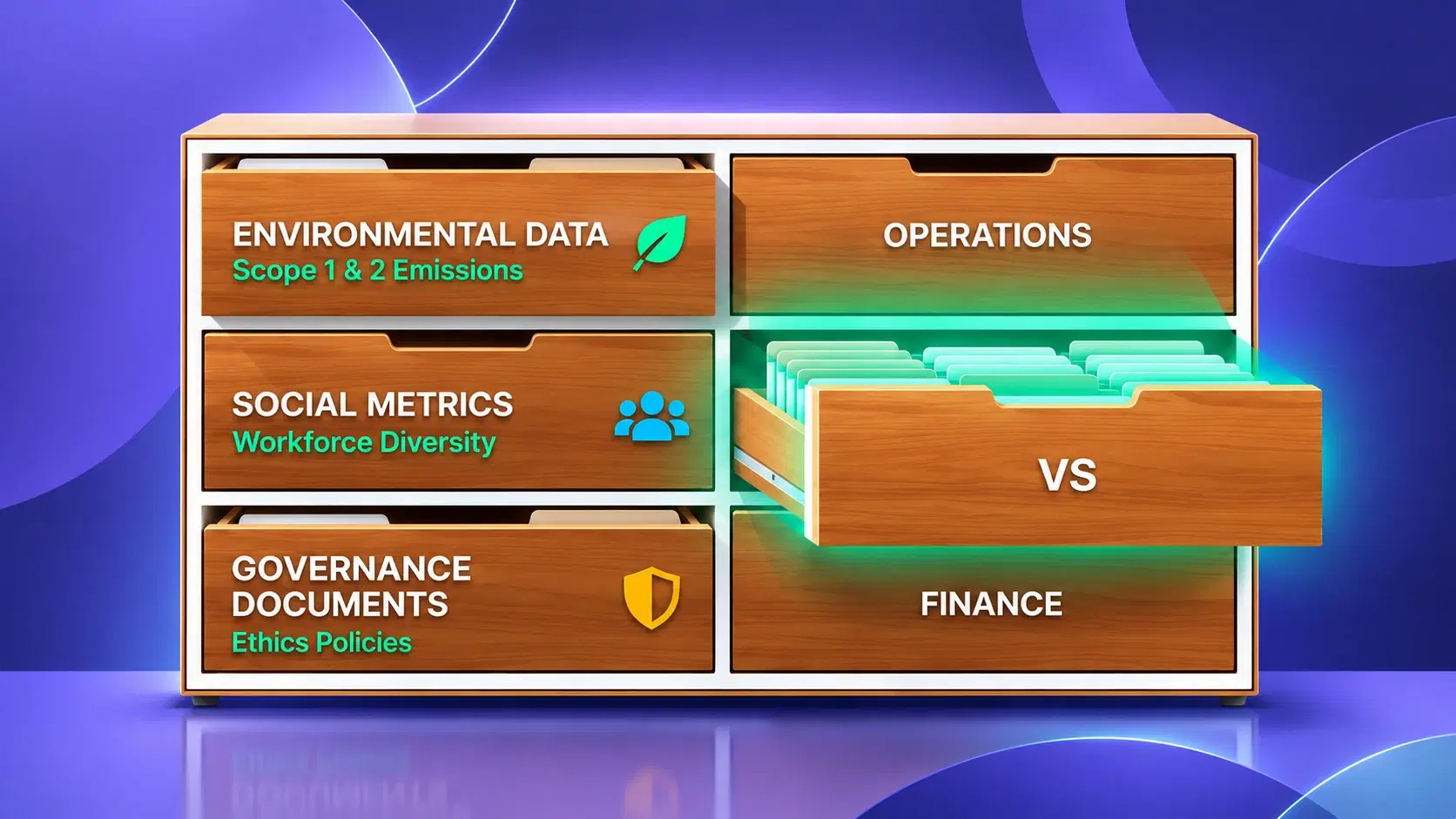
The acronym seemed to appear out of nowhere — in conversations with clients, in an email from your bank, or in a meeting about sustainability.
VS. Or VSME, as it was known until recently.
And the question that follows is always the same: what is it, and do I really need to worry about it?
The short answer: VS is the European ESG reporting standard created specifically for SMEs, and recently extended to all non-listed companies with fewer than 1,000 employees.
It is voluntary. But it may be exactly what your company needs to organise, communicate and give value to what it already does on sustainability, without the bureaucracy of the standards designed for large companies.
This guide explains everything: what VS is, how we got here, what it requires, who it is for and how to get started. No unnecessary jargon.
From VSME to VS: what changed with the Omnibus
Before: VSME
The standard was born as VSME — Voluntary Sustainability Reporting Standard for SMEs. The acronym said it all: it was an instrument designed for small and medium-sized enterprises that, although not covered by the CSRD (Corporate Sustainability Reporting Directive), were under growing pressure from clients, banks and investors to provide sustainability data.
2025: the Omnibus package
In 2025, the European Union launched the Omnibus package, a far-reaching reform of the sustainability regulatory ecosystem. The aim was to simplify, reduce the burden on companies and make reporting more proportionate. One of the consequences of this reform was a significant narrowing of the scope of the CSRD, to companies with more than 1,000 employees and more than €450M in turnover.
Now: VS
Accordingly, the European Commission issued a formal recommendation: large companies and financial institutions covered by the CSRD should base their ESG information requests to suppliers on VS. At the same time, the scope of the standard was extended to also cover large non-listed companies of up to 1,000 employees that fell outside the scope of the revised CSRD. Once the scope was no longer exclusively SMEs, the name followed: VSME became VS — Voluntary Standard.
The structure of the standard remains the same. What changes is the context: VS has stopped being a peripheral alternative and has become the market reference for all voluntary sustainability reporting in Europe.
For an SME, this has a concrete implication: when your large client asks you for ESG data, the request is most likely to be structured around VS. And if your company has fewer than 1,000 employees, you have the right, from financial year 2027, to refuse any request that goes beyond what VS provides for. This is an explicit protection that the regulatory framework now enshrines.
What VS is and where it comes from
VS is the European sustainability reporting standard developed by EFRAG (the European Financial Reporting Advisory Group) for companies not listed on a stock exchange.
The problem
It was created in response to a real problem: the CSRD requires large European companies to report detailed ESG data. To do so, they need information from their suppliers, most of which are SMEs. But the existing frameworks were too complex and disproportionate for companies with limited resources.
The solution
VS closes that gap: it offers a structured, proportionate and recognised path so that any company can report credibly, without replicating the processes of a large corporation.
VS is a VOLUNTARY standard. It will never be directly mandatory for SMEs. What exists are indirect pressures — from large clients, banks and investors — that make adoption advantageous. And now also a protection: companies with fewer than 1,000 employees have the right, from financial year 2027, to refuse requests that exceed what VS provides for.
Who is VS for
VS was designed for companies not listed on a stock exchange, regardless of sector. In practice, it is especially relevant for:
SMEs that supply large companies covered by the CSRD and receive — or expect to receive — requests for ESG data.
Companies applying for green financing or credit lines with ESG criteria.
SMEs with investors or shareholders who request sustainability data.
Large non-listed companies that fell outside the scope of the revised CSRD and want to maintain credible sustainability reporting.
Companies that want to structure and communicate their sustainability practices in a way that the market recognises.
If your company has fewer than 250 employees, the VS Basic module is the right starting point. If it has between 250 and 1,000 employees and is not directly covered by the CSRD, reporting on both the Basic and Comprehensive VS modules is probably the most suitable option.
What VS asks for — the three ESG dimensions
The VS requirements are organised around the three classic ESG dimensions: Environmental (E), Social (S) and Governance (G). Understanding what each dimension covers helps you see what your company already monitors, and what still needs to be organised.
General Information
This covers the basis for preparing the report, including general information about the entity, sustainability-related certifications, and future practices, policies and initiatives for the transition to a more sustainable economy. The Comprehensive module also includes descriptions of the business and sustainability model.
Many SMEs already implement sustainable practices without formally knowing it — certifications, energy efficiency measures, supplier policies. The challenge is usually to gather that information and describe it in a structured way.
Environmental Disclosures
This covers the company's impact on the environment: CO₂ and other greenhouse gas emissions (Scope 1 and 2, with reference to Scope 3), energy consumption, waste management, water use and exposure to climate risks.
Most SMEs already have data on energy consumption and waste, such as electricity bills, meter readings and waste collection records. What is usually missing is organising it into a format that can be communicated.
Social Disclosures
This covers the company's practices in relation to people: working conditions, health and safety, training, diversity and practices in the supply chain. It also includes the relationship with local communities and consumers.
Many SMEs have solid social policies — training plans, workplace accident records, collective agreements. The challenge is usually to turn informal practices into structured, verifiable data.
Governance Disclosures
This covers how the company is managed: leadership structure, business ethics, prevention of corruption, tax transparency, risk management practices and capacity for innovation. Governance includes innovation as a factor in organisational resilience, a dimension that is increasingly valued by investors and large clients looking for partners with solid, adaptable management structures.
This dimension is often underestimated by SMEs, but it is where the competitive edge becomes most visible in the long term.
The two VS modules
VS is organised into two complementary modules. The starting point is the Basic module; the Comprehensive module goes into greater depth for companies with greater capacity or reporting pressures.
Basic Module
11 disclosure requirements
- General Information
- B1Basis for preparation
- B2Practices, policies and future initiatives for transitioning towards a more sustainable economy
- Environment
- B3Energy and greenhouse gas emissions
- B4Air, water and soil pollution
- B5Biodiversity
- B6Water
- B7Resource use, circular economy and waste management
- Social
- B8Workforce — general characteristics
- B9Workforce — health and safety
- B10Workforce — remuneration, collective bargaining and training
- Governance
- B11Convictions and fines for corruption and bribery
Comprehensive Module
20 disclosure requirements (Basic + 9 additional)
- General Information
- C1Strategy and business model
- C2Description of practices, policies and future initiatives for the transition to sustainability
- Environment
- C3GHG reduction targets and climate transition
- C4Climate risks
- Social
- C5Additional workforce characteristics
- C6Human rights policies and processes
- C7Severe negative human rights incidents
- Governance
- C8Revenues from certain sectors and exclusion from EU reference benchmarks
- C9Gender diversity ratio in the governance body
Most SMEs start with the Basic module — and that is enough to respond to the majority of requests from clients, banks and investors. The Comprehensive module makes sense when there is specific pressure from investors, banks or other stakeholders.
Why adopt VS — the concrete benefits
The decision to adopt VS should be based on tangible benefits rather than abstract pressure. These are the strongest arguments.
Respond to large clients' requests with a credible document
As mentioned, companies covered by the CSRD need ESG data from their suppliers. Having a VS report allows you to respond efficiently and defensibly, without having to create information from scratch for every questionnaire received from large clients.
Improve access to financing
Banks are integrating ESG criteria into credit assessments. Sustainability data organised according to VS — a standard recognised by the European Commission — can positively influence financing conditions and access to green credit lines.
Prepare the company for investor due diligence
In most mergers and acquisitions or private equity fundraising processes, ESG analysis is now part of the standard process. A potential buyer or investor will probably carry out ESG due diligence. Having the information structured in advance speeds up the process and adds value to the company.
Organise what already exists
This is, perhaps, the most immediate reason. Most SMEs already implement sustainable practices — waste management, training plans, supplier policies and monitoring of energy consumption. What is missing is structuring and organising that information. VS provides the framework to do so systematically.
Growing competitive differentiation
As ESG requirements become the norm in procurement processes and banking criteria, having a VS report sets your company apart from those that have not yet started this process. It is a growing commercial advantage, especially in exporting sectors and in the supply chains of large industrial groups.
VS vs CSRD — key differences
Confusion between the two frameworks is common, but the distinction is simple:
| VS | CSRD / ESRS | |
|---|---|---|
| Nature | Voluntary | Mandatory (for large companies) |
| Who it is for | Non-listed companies, SMEs and large companies outside the CSRD | Companies with more than 1,000 employees and more than €450M turnover |
| Complexity | Proportionate — 11 or 20 disclosure requirements | High — hundreds of data points |
| Mandatory third-party validation | Not required | Mandatory limited assurance (audit) |
| Relationship between the two | Feeds the data that the CSRD requires from large companies | May request VS data from suppliers with <1,000 employees; from financial year 2027, they have the right to refuse if asked for more data than VS includes |
VS and the CSRD are complementary. The former is the gateway to the European ESG reporting ecosystem; the latter is the framework that governs the obligations of large companies. With the Omnibus, this complementarity has become more explicit: VS is now the official reference for information requests along the value chain.
How to get started — the first practical steps
The process of adopting VS does not have to be complex. Most SMEs already have between 60 and 80% of the information needed for the Basic module, scattered across different departments, systems and documents.
Step 1 — Run a diagnostic. List the data you already monitor internally: energy bills, waste records, HR data (accidents, training), policies in force. This gives you the baseline to assess the real effort involved. See our guide: ESG diagnostic: how to identify what your company already does.
Step 2 — Identify the gaps. Compare what you have with the disclosure requirements of the Basic module. In most cases, only 2 to 4 items are missing that require new data collection.
Step 3 — Assign internal owners. Each disclosure requirement should have an owner: HR for social data, operations for environmental data, management for governance. Without clear owners, the process stalls.
Step 4 — Choose a support tool. A specialised ESG platform speeds up data collection, structures the VS requirements and can generate the final report in a format recognised by clients, banks and investors.
A company in the ceramics sector took four weeks to complete its first Basic VS report. Most of the time was spent locating data that already existed in different systems — not collecting new information. With an ESG platform, the process was reduced to less than two weeks in subsequent iterations.
Common questions about the process
How long does it take?
For the Basic module, the process of collecting and organising data typically takes between 3 and 6 weeks for an SME with no prior ESG reporting experience. With a supporting platform, this time is significantly reduced. In the following years, the annual effort is much smaller because the data structure is already in place.
Do I need external validation?
No. VS does not require mandatory assurance (audit). Some companies opt for voluntary verification to strengthen the report's credibility with more demanding clients or investors — but this is a decision that depends on the context and the audience of the report.
What data do I need?
For the Basic module, the most common data include: energy consumption (kWh), greenhouse gas emissions (Scope 1 and 2 estimates), waste produced and its destination, water consumed, number of employees and employee turnover, training hours, workplace accidents and information on governance practices. Most of it already exists in the company's systems — invoicing, HR, operations.
Is VS compatible with other frameworks?
Yes. VS was designed to be compatible with the ESRS (the CSRD framework), the PAIs (SFDR Principal Adverse Impacts) that investors request, the GRI (Global Reporting Initiative) and the GHG Protocol recommendations. Adopting VS does not prevent the company from adopting other standards later — on the contrary, it makes the transition easier.
The role of an ESG platform in adopting VS
Adopting VS can be done manually, using spreadsheets and text documents. The efficiency and credibility of the process improve significantly with the support of a specialised platform: disclosure requirements are structured into data collection workflows, different departments can submit information independently, the report is generated in a structured format and an auditable history is kept, making verification and comparison over time easier.
Sustanya was built specifically for this context — SMEs that need to adopt VS efficiently, without depending on external consultants for every data update.
In summary — what to take from this guide
The 6 essential points about VS
From VSME to VS
With the Omnibus package, the standard was revised and renamed. The European Commission formally recommended its adoption as the reference for ESG requests along the value chain. VS is now the market standard for voluntary sustainability reporting in Europe for companies with fewer than 1,000 employees.
Voluntary, but strategic
VS is not mandatory, but pressure from clients, banks and investors makes adopting it increasingly advantageous. And companies with fewer than 1,000 employees now have the right, from financial year 2027, to refuse requests that exceed what VS provides for.
Two modules, start with the Basic
Basic with 11 disclosure requirements, Comprehensive with 20. For most SMEs, the Basic module is enough to respond to 90% of external requests.
60–80% of the data already exists
Most SMEs already monitor energy, waste, training and health and safety. The challenge is to structure it, not to collect it from scratch.
Concrete and immediate benefits
Responding to large clients with a credible document, improving credit conditions and preparing for investor due diligence.
No mandatory audit
VS does not require external verification. Adoption can be done in-house, with or without the support of a platform.
See how Sustanya generates VS-aligned reports.
Sustanya generates VS-aligned reports automatically — with no manual formatting and design work, and no dependence on external consultants.
Book a DemoRead also
How ESG helps Portuguese SMEs access better financing
Why banks ask for ESG data and how to respond
ESG diagnostic: how to identify what your company already does
Start here: map what you already do before any strategy
What changes for SMEs under the new European ESG legislation
Deadlines, who is covered and what to do now
Clients demanding ESG? How to turn an obligation into an opportunity
Six steps to respond to requests from large clients
5 steps to start your SME's ESG journey
The quickest route to a solid foundation, without overcomplicating
Did you enjoy this article?
Subscribe to our newsletter
Receive our ESG articles and updates directly in your inbox.
Subscribe to the newsletter