Sustainability is no longer fashionable. It has become an everyday classic
From Web Summit 2026 in Lisbon, a reading for those who invest in and run companies.
The future, according to Web Summit, is AI and robots
We are at Web Summit in Lisbon, and there is a difference you notice right at the entrance: the number of technology companies focused on sustainability, energy and cleantech is much smaller than a few years ago. This year's theme is, beyond any real doubt, artificial intelligence and robotics.
The agenda confirms the impression. Euronews describes an edition marked by a record presence of Chinese companies, by humanoid robots speaking on stage and by a conversation that moves from software that generates text and images to autonomous agents that interact directly with the public (Euronews).
2023
The event had a track dedicated to sustainability (planet:tech) and described environmental startups as one of the fastest-growing categories (Web Summit).
2025
AI and machine learning were the sectors with the most exhibiting startups, about one in every five.
2026
Of the 78 Portuguese startups present, the most represented areas are AI and health.
Sustainability has not disappeared from the 2026 programme, but it is no longer at the centre of the conversation.
The risk of misreading: "sustainability is no longer interesting"
Web Summit is, by nature, a showcase of the future. That is why part of the investment community may draw a hasty conclusion: if the future is AI and robotics, sustainability must have lost relevance in investment decisions and portfolio management.
Our reading
On our side, the conclusion is the opposite. What is fashionable on stage is one thing. What creates or destroys value in companies is another. The impact and the creation (or destruction) of value associated with ESG factors are still there, but they no longer need applause to exist. They have gone from a trend to management routine, as happens with all classics, and we can see it in this very case.
Diversity: a case where years of effort show
In Web Summit's case, the topic of Diversity, Equity and Inclusion (DEI) is one of the most relevant for creating impact and value. And there is a very positive sign worth mentioning. The support Web Summit has given to women's participation is producing results, at the event and in the industry. According to Web Summit's own data, the presence of women among attendees has evolved as follows:
25%
of attendees were women in 2013
42%
in 2016
50.5%
in 2021, surpassing men for the first time
At the 2025 Lisbon edition, 40% of the startups had been founded by women.
Why does this matter for companies and for those who invest? Because gender diversity in leadership is associated with superior performance. McKinsey's most recent study (Diversity Matters Even More) indicates that companies in the top quartile for gender diversity on boards of directors are 27% more likely to outperform financially those in the bottom quartile (McKinsey). For executive teams, the earlier study pointed to a 25% higher likelihood of above-average profitability (McKinsey, 2020).
+27%
likelihood of outperforming financially, for companies with greater gender diversity on boards of directors
+25%
likelihood of above-average profitability, for executive teams (earlier study)
A note on rigour
McKinsey itself warns that this is correlation, not causation. Even so, the pattern holds across several studies over several years.
In companies, more diverse teams tend to see risks and opportunities that a homogeneous team does not. And that has a direct effect on the quality of decisions, on talent retention and, in the end, on exit value for investors.
What the storm taught us: climate adaptation is risk management
There are topics that fashion has left behind and that remain decisive. Adaptation to climate change is one of them.
The second day of Web Summit did not take place. The Government recommended suspending the event because of Storm Charles, citing the risk of flooding from high tides, serious disruption to public transport and the effect of strong wind on outdoor structures. Winds of up to 120 km/h were expected, with around 70,000 attendees, most of them from abroad, moving around the city.
This decision reflects the physical risk assessment that the most advanced companies already build into their ESG analysis: estimating the probability of an extreme weather event and translating its consequence into expected financial loss (halted operations, damaged assets, supply chain disruption). The calculation logic is simple:
Risk
Probability × Consequence
In Lisbon's case, the probability of the storm arriving was high and had been communicated. The potential consequence was enormous: the safety of tens of thousands of attendees at stake, a disrupted public transport network, temporary structures exposed to damage. The decision to cancel follows from both variables having been identified in time.
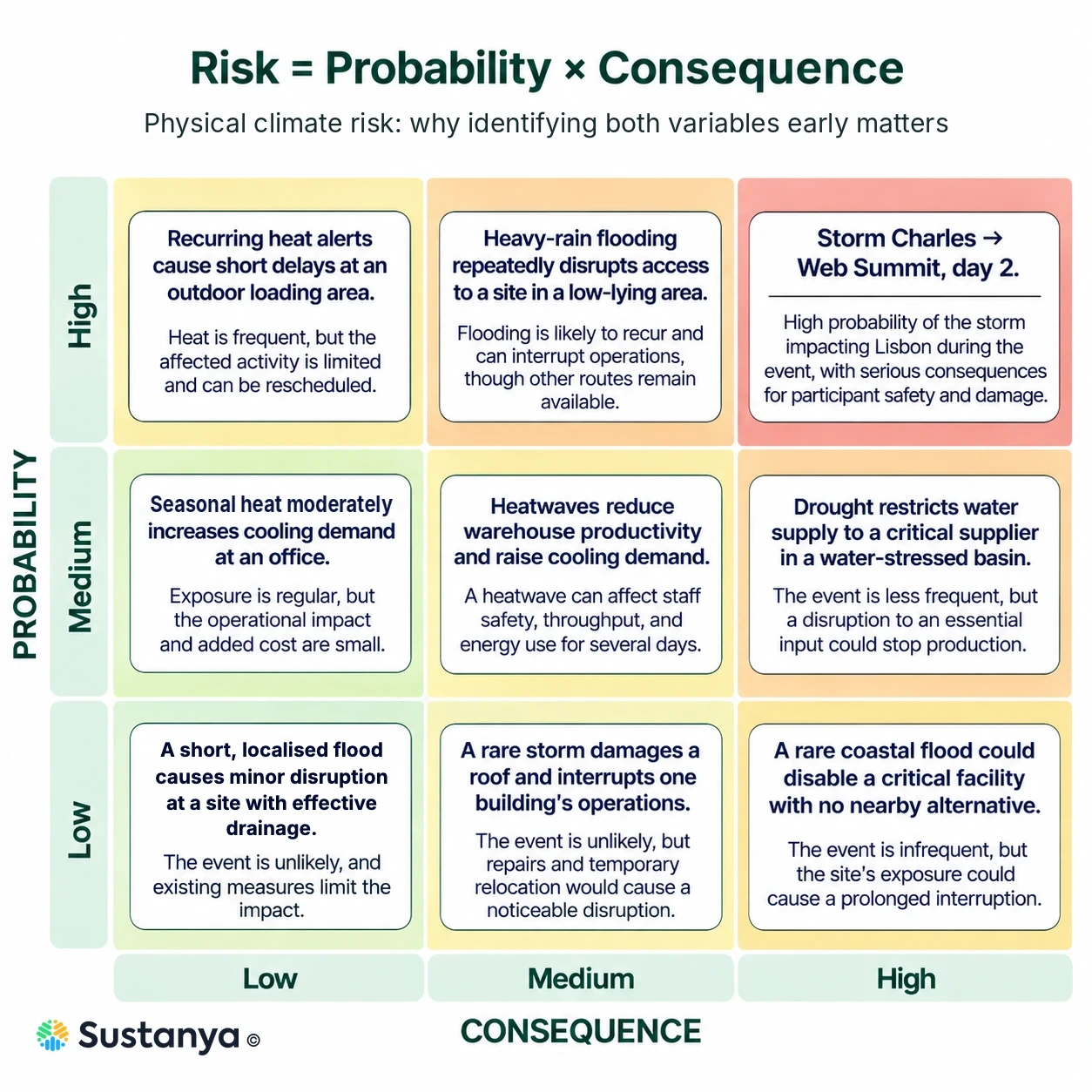
This is where AI, so present on Web Summit's stages, can play a very concrete role. Forecasting models, geospatial data analysis and scenario simulation make it possible to estimate probabilities in advance and in more detail. They also make it possible to map the consequences (which assets, which supply chains, which customers) and to prioritise the actions that reduce the impact. Identify, quantify and adapt: that is the cycle.
Identify
Estimate the probability of the event and map what is exposed.
Quantify
Translate the consequence into expected financial loss.
Adapt
Prioritise the actions that reduce the impact.
What this means for companies and investors
For a fund and for the companies in its portfolio, the practical lessons are these:
1. Identify the ESG topics that are material to the company
Not all topics weigh the same: what is material depends on the sector, the geography and the business model. Knowing which ones actually affect revenue, costs or risk makes it possible to concentrate resources where there is a return and avoid efforts with no impact on value.
If climate change adaptation is relevant
- •Map physical risk by asset and by location. Factories, logistics centres, critical suppliers and offices do not have the same exposure to flooding, extreme heat, fires or wind. This shows where the potential loss is greatest and where to act first.
- •Quantify the consequence in financial terms. Days of downtime, replacement cost, impact on insurance premiums, contractual penalties. Without numbers, the risk does not enter the decision. With numbers, management and investors compare climate risk with any other risk and decide in the same language.
- •Plan adaptation on a cost-benefit basis. Not every measure pays off. Those that do should be in the value creation plan, alongside operational levers. That way, adaptation investment is assessed like any other and protects the company's value.
2. Include material ESG topics in due diligence and value them at exit
An informed buyer will ask about climate exposure and the other material topics. Those who already measure and manage them arrive at the negotiation without surprises and defend the exit price better.
What creates value does not depend on being in vogue
The conclusion we draw from Web Summit is clear: the market's attention has changed, but the fundamentals of value creation have not. ESG may no longer be fashionable, but the ability to identify material topics, quantify risks and opportunities and integrate them into strategy and management remains, today as before, what separates value creation from value destruction. Those who integrate material ESG factors into day-to-day management, with the same metrics and accountability they apply to treasury or quality control, do not depend on market trends to create value.
What Sustanya offers
We help investors and companies turn ESG factors into investment decisions: from assessing material topics to strategy and reporting; from ESG due diligence to exit preparation, with metrics that management and investors can use.
Want to understand which topics are material for your portfolio or company, and what the opportunities for creating and destroying value are?
Talk to SustanyaRead also
ESG Due Diligence in Private Equity Acquisitions: what to assess before investing
How ESG due diligence protects the investor
SFDR and Private Capital: what private equity managers and portfolio company CFOs need to know
SFDR seen from the manager and portfolio company side
ESG diagnostic: how to identify what your company already does
The first step towards an ESG strategy
Did you enjoy this article?
Subscribe to our newsletter
Receive our ESG articles and updates directly in your inbox.
Subscribe to the newsletter